

24th November 2025
Lasting Impact: Crossroads Renewal Project
When your mission is to ‘make our city be the best place in the country to be a child’, where do you start?
At Crossroads Mall, it starts with a seemingly simple school model, where barriers to learning are removed, and each child is provided with access to high-quality education.
We spoke with Chris Brewster, Superintendent of Santa Fe South Schools, to take a closer look at the inspirational Crossroads Renewal Project; a project that hopes to achieve long-term growth, development, and opportunity in an underprivileged community.
MR: Tell me how you got started Chris – what’s your background?
CB: My background is in education; I am a charter school superintendent and had the honor and privilege of starting a school over 24 years ago to serve underprivileged communities in Oklahoma City. This school now serves just under 5,000 children.
I also serve as board chair for the Crossroads Renewal Project.
MR: How did your experience in education grow into a mission reaching far beyond one school?
CB: One of my passions is finding ways to make our children healthier and happier—considering what we could do as a community to provide a better, more nurturing, and healthier environment for our children to grow up in.
Education is simply critical to human flourishing. At a macro level, we know highly educated children are more prone to go to college. College educated people generally can access better jobs, make more money, and pay more taxes—you can put a dollar value on a high school dropout vs high school graduate vs college graduate. In Oklahoma City, 90% of Oklahoma City Public School kids qualify for free or reduced price meals at school. Managing the reality of poverty has a profound impact on their likelihood of going to college or reaching their full potential. So the long-term game plan is a generational shift in the poverty levels of our community.
Unfortunately, the problems that are endemic to high-poverty communities are profoundly difficult for children to overcome. I felt like there must be a better way to educate and engage these children.
I started to look for durable school reforms that would last longer than one leader, not reform du jour, but things that would have an impact long-term.
I came across the community schools model. Profoundly unsexy, not fancy, almost irritatingly simplistic.
What it proposes is this: If there are no barriers between the educator and the learner, more high-quality education is likely to take place. In a situation where children can receive the education without unnecessary speedbumps along the way, the learning outcomes are more profound.
MR: What kinds of barriers do you see?
CB: Education can be the frontline of defense for so many unrelated things, especially in high-poverty communities. For example, making sure kids have food; their emotional wellbeing; their health—all of these things take time, energy, and resources.
The teacher becomes the one delivering these frontline social services over and over again, and when they’re doing this they are not teaching.
Additionally, time lost from school for things like health issues create further barriers. Poverty stricken children will lose many days of classes due to issues as simple as dental health because residents of under-resourced communities need to drive all over town to find affordable places of care. As a result, something as simple as a cavity ends up becoming an abscess and then an extraction, and then the child loses weeks of teaching to something that should have been cared for and prevented.
The core question we ask is, “Can we make our city the best place in the country to be a child?”—and everyone rallies around that idea and is very engaged. Empirically, we can unfortunately prove our city is one of the worst places in the nation to be a child. It would seem we are content with very poor health and education outcomes and recurring poverty. With the Crossroads Renewal Project, we are calling people to solve really challenging problems, but to do so in a collaborative and systematic way.
MR: How do you foresee removing some of these barriers?
CB: Placing these critical services in proximity to schools closes this gap very rapidly. By putting, for example, a dentist in the school and a doctor in the school, students can get treated and back in class. If children are healthy, they can learn well. This is the community schools model. With Crossroads, we started playing around with the idea of scalability.
What if we could provide high-quality academic environments around a core of social services so that we could serve large numbers of children and families in profoundly impactive ways? And this is where the concept of an integrated school and service hub started to emerge.
MR: What was your next step?
CB: We started off thinking about size and space, and Crossroads Mall seemed like the perfect solution. Malls, like many around the world, are needing to be re-purposed—Crossroads Mall is an existing building, in a central location, so it ticked a lot of boxes.
Santa Fe South moved in about seven or eight years ago, starting with one of the mall’s four massive anchor stores, each about 200,000 sq ft spread over three floors. The interior concourse itself spans 365,000 sq ft over two floors.
What used to be a retail store became Santa Fe South’s flagship high school, home to roughly 1,000 students. Later, a middle school moved into the top floor, adding another 800 students to the building—1,800 in total under one roof.
Four years ago, we expanded again, acquiring the northernmost anchor store and transforming it into an elementary school that now serves 600 children. Today, Santa Fe South owns 26 acres and two of the four anchor stores.
The rest of the property—the mall concourse, the other two anchor stores, and 64 additional acres—was acquired by the nonprofit, the Crossroads Renewal Project (CRP), in order to develop with a mix of healthcare and service providers.
Across the ring road that encircles the property, there’s also another high-performing charter school with 1,600 students. Together, the two schools serve nearly 4,000 children at this specific location, either directly on-site or immediately adjacent. The steady flow of families to and from the property twice a day creates a critical mass of foot traffic—exactly the kind of energy needed to bring a space like this to life.
MR: What kind of impact has the project had to date?
CB: Visitors can see that the schools that have already been repurposed are full of thriving kids. They don’t need to imagine what it’s like to have life back in the space, life is there for observing! Public charter schools tend to struggle with facilities. They don’t receive the same public funding to buy or build facilities which makes them radically restricted in their growth. In this mall space we have been able to do the redevelopment of the property at a fraction of the cost and demonstrated what can happen if you repurpose industrial space with an eye for value and efficiency.
We have been able to build out quality education space for less than half of what local public school districts are spending. If you really are thoughtful in the design-build process, you can build much more economically, serving as a better steward of the public dollar.
MR: It sounds like you have two really fantastic school models in place already – what else do you see happening in terms of growing education opportunities at the Mall?
CB: We are considering the build out of more secondary seats in one of the other anchor stores. As we grow out another several hundred quality seats in the space, these can be various school iterations such as vocationally specific secondary environments with industry certificates; a leadership academy and an early college model high school program.
Also welcome are private schools, micro schools, and incubation for school start-ups. When fully iterated, we hope to have 5,000 to 6,000 kids in the mall property and adjacent in really high-quality schools of all types.
We’re open to any type of education, as long as it’s high quality. And we have to have collaborators in all areas, whether that’s schools or other partners.
MR: Let’s talk more about the collaborators; outside of education, tell me more about the other services and potential collaborators that are key to making this work?
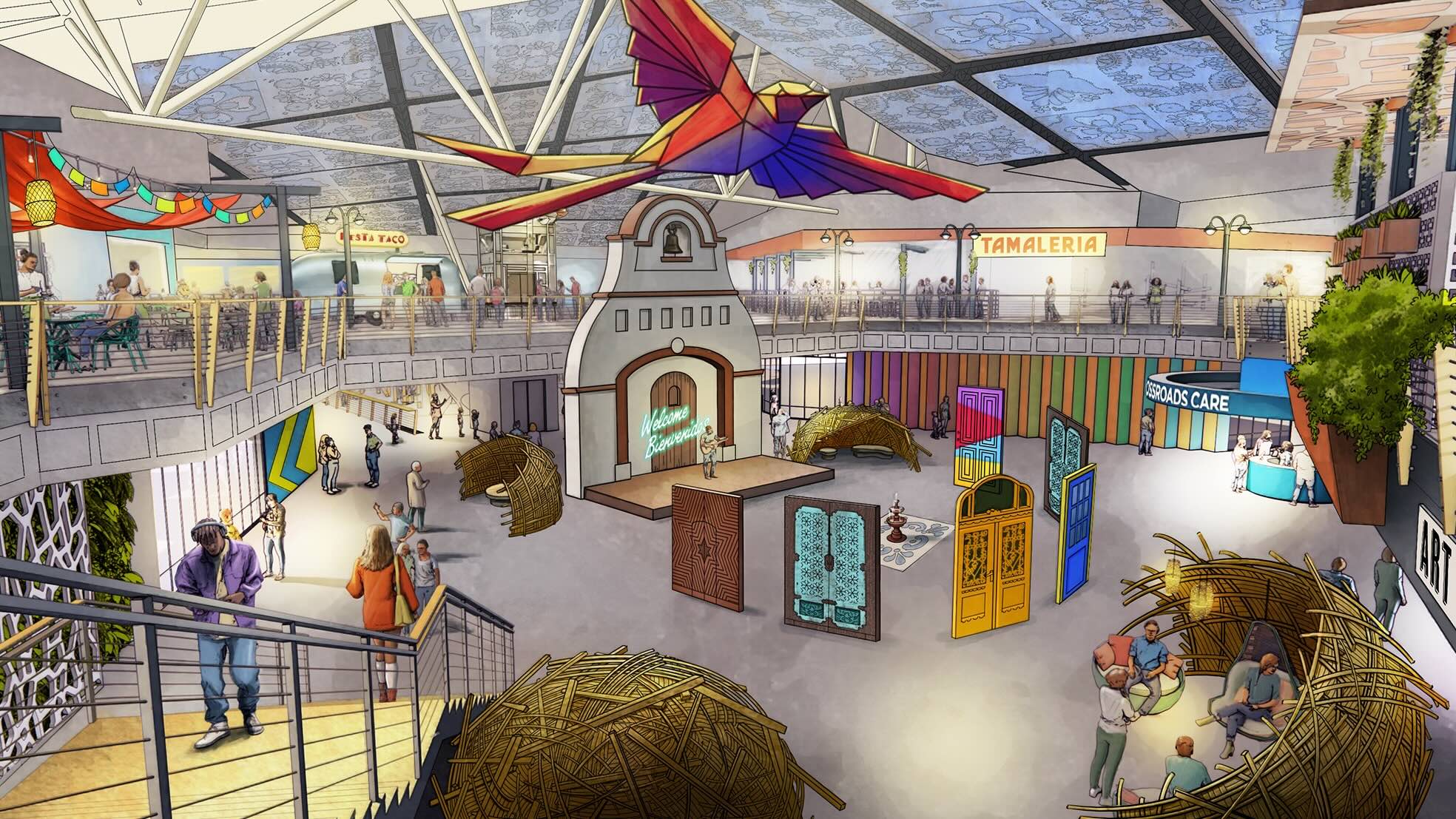
CB: Our mission has evolved to be a calling together of people with good conscience in the city to concentrate goods and services in once space – the mall concourse has basically been redesigned as a new ‘main street’ for South Oklahoma City. All the activities, childcare, grocery stores, and banks are in proximity to the people we serve.
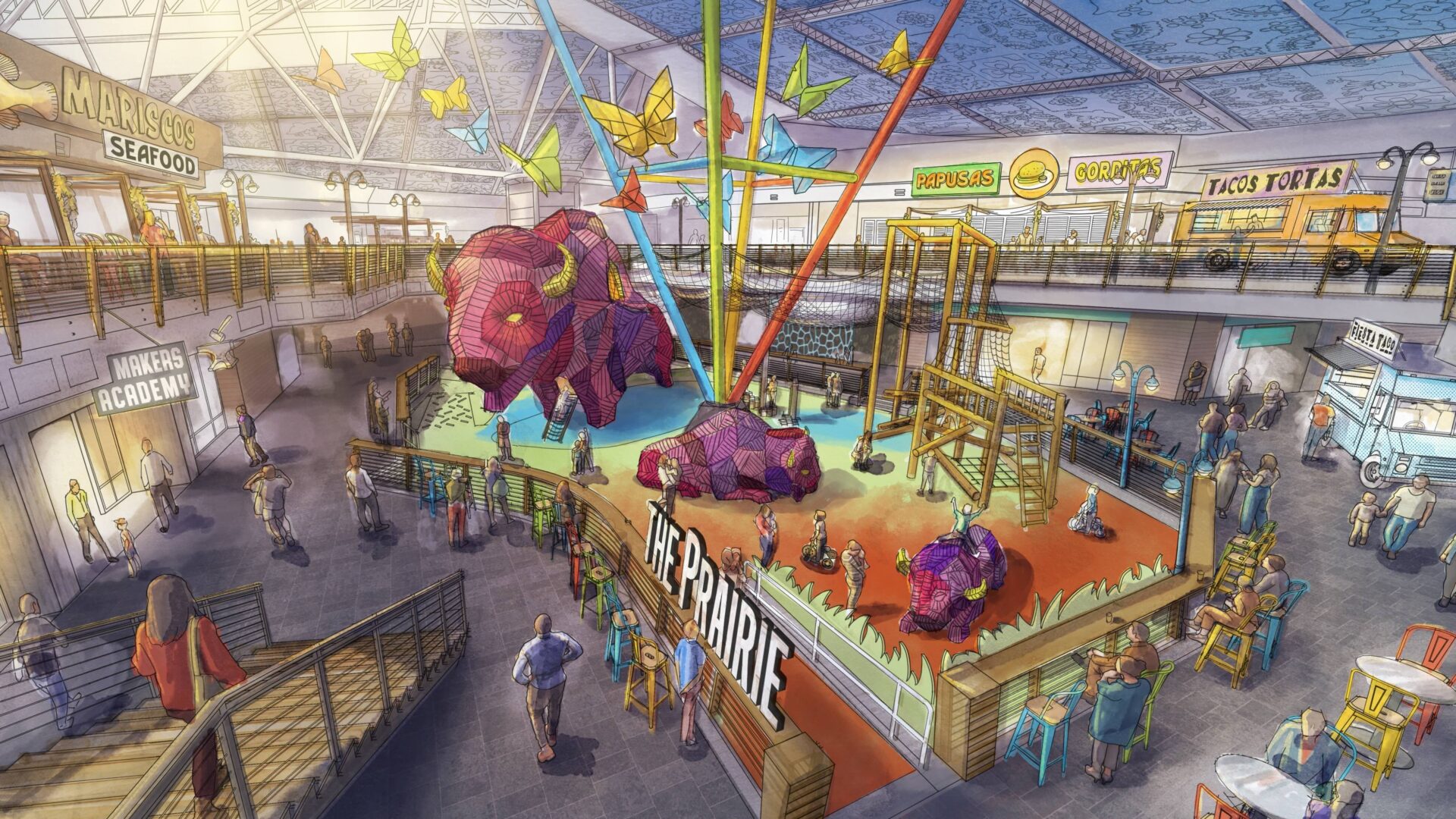
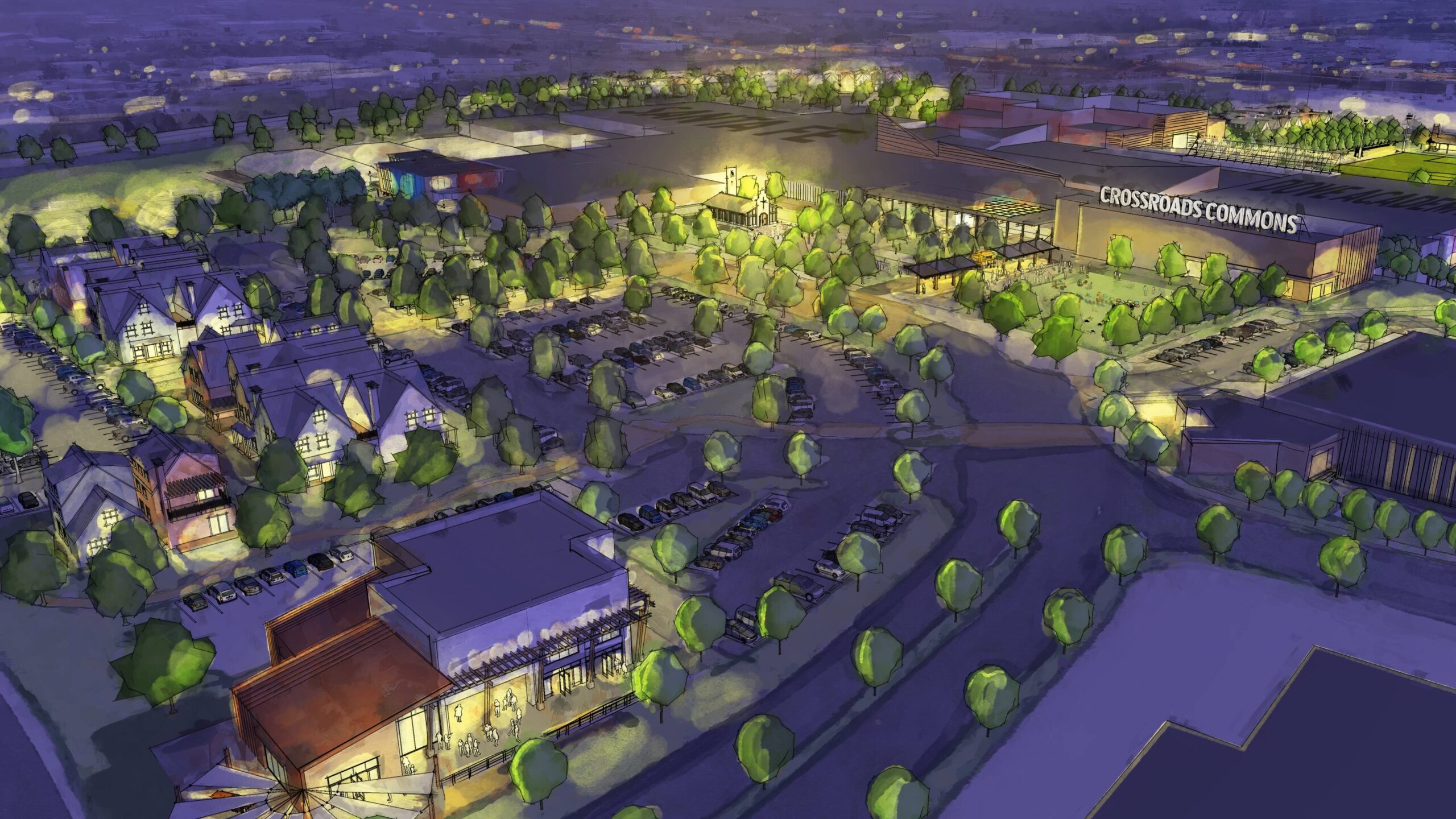
One of the most enjoyable things is exploring how to make this space beautiful and enjoyable. Storyland was exceptional in bringing this to life, the way it looks, the way it flows, the play spaces, the recreation, the restful spaces. Creating a place that draws people in where they can meet with a friend or go to a small business incubation space.
Importantly, the businesses that we invite in have to be able to prove that they will be both sustainable and successful at meeting their mission. Companies need a world-class product, and a world-class mission. E.g. for a coffee shop, instead of Starbucks, we have a ‘Not Your Average Joe’—a successful non-profit coffee shop where 70% of the workforce are special needs adults.
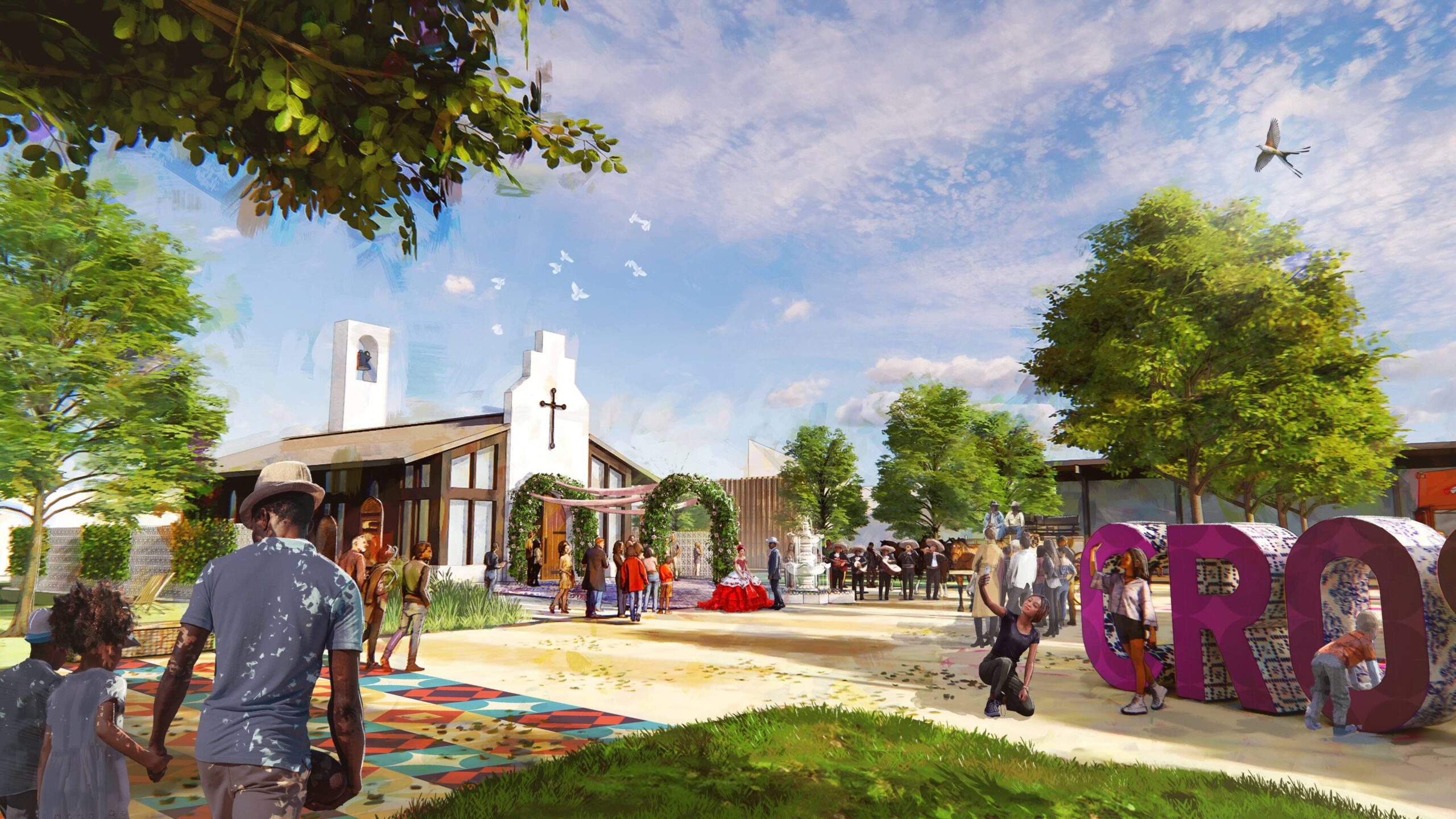
We’re also looking at green spaces and biodiversity, filling green spaces with plants that are native to Oklahoma. The outside space is a sea of asphalt right now. We have probably 65 acres that are paved with very little green space. The concept drawings literally turn this place into a green space and a park for the community, for families. Being able to turn the outside, the exterior space, into a much more community-friendly space is something we’re very focused on.
MR: What options are you looking at for healthcare?
CB: Quality healthcare is the most important component of the Crossroads Renewal mission, and the most complex to execute. We have one hospital and many providers who want to lease space with us, but we were not sure how to organize them all. Thankfully, Dr. Reid Hebert of Hilltop Clinic, who serves on the board of CRP, has agreed that Hilltop Clinic is equipped to step in and organize the healthcare facilities, and all healthcare providers will operate in the top floor of one of the box stores.
Dr. Reid Hebert shared a story that captures the challenge: he might diagnose a child and prescribe medication, only to see them sick again weeks later, not because the treatment didn’t work, but because the parent couldn’t get to a pharmacy that accepted their insurance.
In our healthcare hub, the pharmacy will be right next to the clinic, alongside orthopedic care, physical therapy, and other essential services. Everything will be in one place, with multilingual staff ensuring families get the help they need without navigating the usual maze of healthcare. This solution is designed around wellness, not sickness.
MR: What would you say are the main challenges you’re facing at the moment?
CB: We need to be at 58% occupancy and just below market rates in rent to be sustainable, which is our goal for 2028, moving to full capacity in the following years.
We intend for this to be sustainable long-term and not built on constant contributions, which also means we need everybody to thrive.
We have 120,000 sq ft in initial commitments and need 225,000 committed inside the interior space. We’re burning hard between now and January to circle up these folks.
It’s not a typical development with investors. This is a non-profit staged build up, and although the concept looks good on paper, we’re having to prove the possible, as it’s not available anywhere else in the country. Yes, malls are being repurposed, but they’re not being repurposed around the core of thriving children.
MR: What are the potential obstacles to the realization of this vision?
CB: This is a giant, complex project that may not work in the way we ideally envision it to be. If the philanthropic community does not feel the calling that we do, then our plan would be to still maintain the schools and the healthcare component, but to demolish the concourse and turn it into a green space. At the very least, we’ll be building a space that is good for kids. Ultimately, we could make our vision smaller…but hopefully not!
We’ve processed through due diligence, raised $9.5 million for the acquisition of the space, and had 300+ meetings with individuals and organizations that have expressed an interest in the space. There’s a lot of momentum to bring this back to life, so we are optimistic.
MR: What would you say is your biggest hope for the future?
CB: What Storyland has done has been exceptional in keeping this vision alive and forward facing. When I show my concept deck with the artist renderings, it speaks to people through the way it values kids and desire for the city to thrive and I cannot overstate how valuable that is!
I want to prove the possible—high-quality education and healthcare, and a collection of services that provide a concentric circle around the community, but also a place for people to drive to at night and weekends because it’s a beautiful place for families to be.
The most valuable asset in our state is not oil and gas or sports teams, it’s our children! Brilliant potential leaders, pastors, doctors, parents, teachers, astronauts—as long as we’re wise and we invest.
About Crossroads Renewal Project
Crossroads Renewal Project is reimagining Oklahoma City’s historic Crossroads Mall into a thriving community hub dedicated to making the city the best place in the country to be a child. Anchored by Santa Fe South Schools, the redevelopment aims to combine high-quality education, healthcare, retail, dining, and green spaces while removing barriers to learning and opportunity. Backed by local foundations and community partners, Crossroads is transforming an abandoned mall into a model for sustainable, child-centered urban renewal.
About Storyland Studios
Storyland Studios is a full-service experience design firm with offices in the US and Europe. We imagine, design, and create immersive experiences and environments that lift the Spirit. Storyland Studios team Members and Executive Leadership include alumni from The Walt Disney Company, Walt Disney lmagineering, Pixar Animation Studios, Universal Studios, and LEGOLAND® – all passionate about creating immersive storytelling experiences that shape culture and connect with people on an emotional level.